
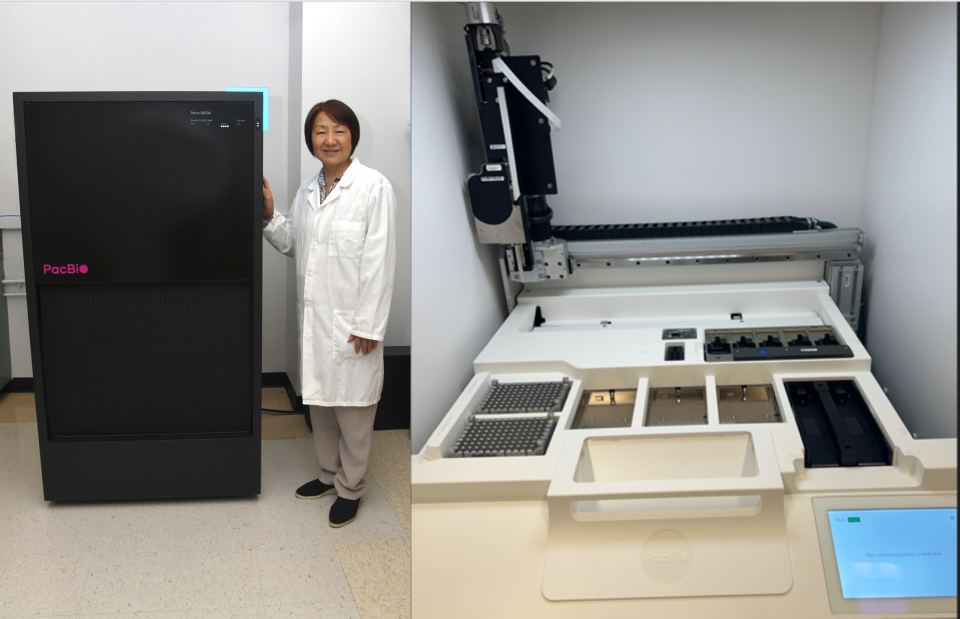
Could you explain to our audience what the Pacbio Revio instrument is and how it differs from previous sequencing technologies?
The Revio is a new long-read and third-generation sequencing instrument developed by Pacific Biosciences and launched last October. It is a major upgrade of PacBio’s single-molecule real-time sequencing (SMRT) technology which was launched to the market a decade ago, and the circular consensus sequencing (CCS, the HiFi reads) method that was launched to the market in 2019 and implemented in the Sequel II sequencer. HiFi sequencing produces reads that are long and accurate (15-20 kb with 90% of bases Q30+) and include 5mC methylation in standard libraries. The system uses a nanotechnology called zero-mode waveguides (ZMWs). The Revio flowcell has 25 million ZMWs, up from 8 million ZMWs on the Sequel II flowcell, and Revio outruns Sequel II in throughput by 15-fold. Since Revio runs four flow cells simultaneously, customers can sequence 1,300 whole human genomes a year at 30X coverage. In contrast, Sequel II enables customers to run 88 whole human genomes a year at 30X coverage. In contrast to the short-read sequencer, HiFi reads are more appropriate for de novo genome assembly, haplotype phasing, 5mC detection, structural variant identification, full-length mRNA sequencing, and mRNA isoform discovery. This improves results for complex applications such as single nucleotide and structural variant detection, genome assembly, assembly of difficult polyploid or highly repetitive genomes, and assembly of metagenomes, etc.
That sounds promising. Could you elaborate on how the Pacbio Revio instrument will specifically benefit Weill Cornell Medicine's research?
TIn addition to Illumina short-read, the second-generation sequencing platform that we installed and upgraded continuously in the past years, the acquisition of the PacBio Revio system will significantly enhance our current genomics capabilities and pave the way for groundbreaking discoveries for Weill Cornell Medicine community. With its highly accurate HiFi long-read sequencing technology, it will enable users to delve into previously uncharted regions of the genome that were inaccessible with other sequencing platforms. By doing so, reseachers can uncover important genetic variations, structural rearrangements, and epigenetic modifications that play fundamental roles in human genetics, cancer research, and evolutionary biology.
Could you provide us with a specific research application where the Pacbio Revio instrument will make a significant difference?
Let's consider two specific research applications where the Pacbio Revio instrument will have a transformative impact.
Firstly, in the study of human diseases associated with repetitive DNA elements, such as expansions of trinucleotide repeats, accurate sequencing using short-read technologies has been a challenge. However, with the Pacbio Revio's long-read capability, we can confidently sequence through these repetitive regions and precisely determine the number of repeats. This information is critical for understanding the underlying mechanisms of the disease and developing targeted therapeutic interventions.
Secondly, in the field of cancer genomics, the Pacbio Revio instrument will revolutionize our ability to unravel the complex genomic alterations that drive tumorigenesis. By harnessing its long-read sequencing technology, we can overcome the limitations of short-read sequencing and capture comprehensive information on fusion genes, structural variations, and alternative splicing events. This deep sequencing capability will enable us to identify novel biomarkers, gain insights into tumor heterogeneity, and ultimately develop more precise and personalized treatment strategies for cancer patients.
The Pacbio Revio instrument's long-read sequencing technology will have a significant impact on our research. It will enable accurate analysis of repetitive DNA elements in human diseases and provide comprehensive insights into complex genomic alterations in cancer, leading to advancements in disease understanding and the development of targeted therapies.
It's fascinating to see the potential impact on cancer research and human diseases. Are there any challenges or considerations when utilizing the Pacbio Revio instrument?
While the Pacbio Revio instrument offers incredible advantages, it is essential to acknowledge a few considerations. First, the instrument requires high-quality DNA as input, the poor-quality samples, e.g. FFPE, and low concentration (< 1ug) would not be supported yet. Additionally, the data analysis and interpretation for long-read sequencing would require learning new tools and approaches. However, with PacBio SMRT Link, the powerful web-based end-to-end software workflow manager for run design and set-up on the Revio System, Data Management, and SMRT Analysis, and together with our dedicated team of bioinformaticians and the Scientific Computing in ITS who are skilled in handling these challenges, we will ensure to extract accurate and meaningful information from the data.
As we wrap up, could you provide a brief summary of the main benefits of acquiring the Pacbio Revio instrument for our audience? Additionally, could you let us know when you anticipate the instrument will be fully operational and ready for utilization?
The acquisition of the Pacbio Revio instrument heralds a new era of genomics research at Weill Cornell Medicine. Its long-read sequencing technology enables us to explore the intricate details of the genome, leading to breakthroughs in our understanding of human diseases and facilitating the development of more precise diagnostic methods and targeted therapies. We anticipate that the instrument will be fully operational and ready for utilization starting from July 1st. We are excited about the possibilities that lie ahead and the transformative impact this instrument will have on our research endeavors.